The Subjectivity In Determining Objectivity (
Objectivity is not something that can easily be attained and, in fact, some even argue that it is not humanly possible. The way we perceive even mundane events is filtered through our religious, social, and political preferences; all information we process is stored in context with other information, thus typically involving stereotyping, the forming of preconceived notions and the discriminating of certain facts
Journalists are trained to be committed towards objectivity and professionalism, but this is a very difficult undertaking; the overall consensus among media analysts is that objective fact model is not in sync with the nature of news coverage, and that the profit seeking model seems to be the most accurate representation of reality. Providing coverage of one issue over another, the terminology and rhetoric used to describe a particular event, and the extensiveness of the coverage of a particular news event are all examples of mundane reporting, that can be inadvertentlytake a stance, without the provision of any analysis.
Which brings us to Al Jazeera; in Aljazeera.Net - About Aljazeera it declares its commitment to "cover[ing] all viewpoints with objectivity integrity and balance” and “present[ing] diverse points of view and opinions without bias or partiality.”
Indeed, Al Jazeera’s very basis is unlike any other perfessional news organization in the Arab world. Since it is not linked directly to the government, it does not face the censorship and harsh restrictions typical among the other news networksm and thus is not compelled to produce information strategically spoon fed by the government. It also embraces Democratic principles by encouraging interactive feedback and bringing in more than one viewpoint on an issue in order to foster debate. In fact, Aljazeera.net English goes as far to describe its purpose as "to cater to people with diversified interests from continents poles-apart and offer a versatile content of news and information."
Since there is a huge discrepancy between the Arab and Western system of values and ideologies, there no doubt exists a clashing of views as to what constitutes fair and objective news coverage, and to the vast majority of Americans, Al Jazeera’s coverage is far from objective. Countless arguments and evidence have been amassed where Al Jazeera provides coverage that was considered blatantly anti-American. Many refer to it as a mouthpiece for al Keida--a means of providing propaganda disguised as professional news. Government officials such as former secretary of defense, Donald Rumsfeld, and current secretary of state Condoleezza Rice, have harshly criticized Al Jazeera saying that it has emerged as even more anti-American since 9/11.
Al Jazeera’s claim of Jews knowing in advance of September 11 and thus not attending work at the World Trade Center the day of the attacks infuriated many. There was no evidence to support this claim, and yet it was broadcasted as a serious, substantial piece of news in the Al Jazeera’s news network. More recently, they’ve been denounced for using the term "martyr" in newscasts to describe Palestinian suicide bombers who have killed Israeli civilians. But Al-Jazeera denies anything unfair or biased about this, and contends that the term is used for all Palestinians who die fighting a "cause," not just suicide bombers.
Wednesday, November 15, 2006

Monday, November 13, 2006
The Nazi-Propagandist Distortion of Reality
The German propaganda historic archive shows a series of evidence of Nazi propaganda. Examining the propganda implemented in documents, news articles, cartoons, ads, billboards, and speeches can help provide a greater understanding as to why Hitler was so effective in swaying public opinion and stimulating the masses to embrace his ideologies that had started out as radical, but ultimately became widely appealing replacing the status quo. Hitler’s effective exploitation of propaganda was the primary reason for his success as a leader. From the begining his campaigning ads targeted and exploited precisely the emotive appeal. He catered to the frustrated, anger and embitterned.
The imagery and rhetoric he implemented was extremely potent. This one ad which shows numerous desperate hands receiving food, was said to be one of the most effective ads. (Unfortunately I couldn't upload it, i will try again )Many other series of advertisements were effective in terms of characterizing Hitler as a strong competent leader who would grant them respite from all their social, and economic sufferings, that permeated the post-World War I era.
Hitler’s campaigning catered particularly to the hungry and embittered proletariat. Through his craftiness and duplicity, he expertly channeled basic mundane issues, such as the widespread dire need of food, jobs, and security toward invigorating anti-Semitism. Disgust with the Third Reich government, and the need of social and economic reform, would not have so overwhelmingly resulted in the hatred of Jews, were it not for Hitler implementing a casual-effect relationship between the two otherwise unrelated entities. Hitler used the classic scapegoat appeal; he expertly channeled the widespread anger and frustration with social injustices and used it to dig up and a revitalize a hatred of Jews that dated back centuries via creating hyperbolic images and caricaturized drawings of Jews as a notorious hooked nose, money hungry, sleazy group of people out to dupe the Aryan race.
The Nazi campaigning and the messages and information put forth once they were elected illustrate the potency of propaganda. Propaganda can legitimize even the most sinister of agendas. A mere argument for bread and work transformed into a quest for preserving the Aryan race and obliterating the entire Jewish people.. The only way these aspects of Hitler’s agenda could have been implemented was through expertly intertwining this with the widespread social suffering.
One particularly interesting article Hitler wrote is where he realizes, that not everyone will greet and embrace the new status quo in the ideal way, and people will likely question and even object to the new anti-Semitic attitudes and restrictions; thus he implements an iota of “rational” persuasion. In this article (the anti-Semitic arguments ) ten responses are provided as counterarguments to the most common objections among Germans to the new anti-Semitic measures. It used the pretense of “counterargument”, but in reality was a sick and twisted form of providing information. The entire core of the argument is not based on reason, or on any objective evaluation of the claim of a “Jewish problem” Rather it builds on already established myths, provides warped anecdotal evidence to suggest reality, and contains “philosophical” argument that are inherently flawed. It almost screams propaganda, and anyone with half a brain would’ve realized the article for what it was. Yet, people bought into these arguments as well and embraced the values that were put forth.
Hitler’s success was due to an audience that was growing increasingly more susceptible to the powerful hyperbolic images, the metaphoric rhetoric, and the twisted facts called ‘information”, that constituted propaganda. In fact, it would be a flawed and naïve way of thinking that the Nazi strength of power was derived exclusively from the cleverness and expertise of their propaganda. Effective propaganda is impossible without recipients who will adopt what is being suggested. Adults cannot be coerced into adopting beliefs, nor forced to conceptually embrace values that were put forth via propaganda. Yes the information was manipulated and distorted, but even when an audience can distinguish between objective fact-based messages and information full of lies or exaggeration that is inherently appealing, they will tend to prefer the latter. People allow themselves to be seduced by propaganda because it offers them a way of coping. They persist in adherence to certain already established preferences or beliefs despite all the evidence to the contrary; they are willing copartners in this process of self deceit.
There is no better evidence of this than the Germans allowing themselves to enter and participate in the Nazi ideology fantasy world.
The German propaganda historic archive shows a series of evidence of Nazi propaganda. Examining the propganda implemented in documents, news articles, cartoons, ads, billboards, and speeches can help provide a greater understanding as to why Hitler was so effective in swaying public opinion and stimulating the masses to embrace his ideologies that had started out as radical, but ultimately became widely appealing replacing the status quo. Hitler’s effective exploitation of propaganda was the primary reason for his success as a leader. From the begining his campaigning ads targeted and exploited precisely the emotive appeal. He catered to the frustrated, anger and embitterned.
The imagery and rhetoric he implemented was extremely potent. This one ad which shows numerous desperate hands receiving food, was said to be one of the most effective ads. (Unfortunately I couldn't upload it, i will try again )Many other series of advertisements were effective in terms of characterizing Hitler as a strong competent leader who would grant them respite from all their social, and economic sufferings, that permeated the post-World War I era.
Hitler’s campaigning catered particularly to the hungry and embittered proletariat. Through his craftiness and duplicity, he expertly channeled basic mundane issues, such as the widespread dire need of food, jobs, and security toward invigorating anti-Semitism. Disgust with the Third Reich government, and the need of social and economic reform, would not have so overwhelmingly resulted in the hatred of Jews, were it not for Hitler implementing a casual-effect relationship between the two otherwise unrelated entities. Hitler used the classic scapegoat appeal; he expertly channeled the widespread anger and frustration with social injustices and used it to dig up and a revitalize a hatred of Jews that dated back centuries via creating hyperbolic images and caricaturized drawings of Jews as a notorious hooked nose, money hungry, sleazy group of people out to dupe the Aryan race.
The Nazi campaigning and the messages and information put forth once they were elected illustrate the potency of propaganda. Propaganda can legitimize even the most sinister of agendas. A mere argument for bread and work transformed into a quest for preserving the Aryan race and obliterating the entire Jewish people.. The only way these aspects of Hitler’s agenda could have been implemented was through expertly intertwining this with the widespread social suffering.
One particularly interesting article Hitler wrote is where he realizes, that not everyone will greet and embrace the new status quo in the ideal way, and people will likely question and even object to the new anti-Semitic attitudes and restrictions; thus he implements an iota of “rational” persuasion. In this article (the anti-Semitic arguments ) ten responses are provided as counterarguments to the most common objections among Germans to the new anti-Semitic measures. It used the pretense of “counterargument”, but in reality was a sick and twisted form of providing information. The entire core of the argument is not based on reason, or on any objective evaluation of the claim of a “Jewish problem” Rather it builds on already established myths, provides warped anecdotal evidence to suggest reality, and contains “philosophical” argument that are inherently flawed. It almost screams propaganda, and anyone with half a brain would’ve realized the article for what it was. Yet, people bought into these arguments as well and embraced the values that were put forth.
Hitler’s success was due to an audience that was growing increasingly more susceptible to the powerful hyperbolic images, the metaphoric rhetoric, and the twisted facts called ‘information”, that constituted propaganda. In fact, it would be a flawed and naïve way of thinking that the Nazi strength of power was derived exclusively from the cleverness and expertise of their propaganda. Effective propaganda is impossible without recipients who will adopt what is being suggested. Adults cannot be coerced into adopting beliefs, nor forced to conceptually embrace values that were put forth via propaganda. Yes the information was manipulated and distorted, but even when an audience can distinguish between objective fact-based messages and information full of lies or exaggeration that is inherently appealing, they will tend to prefer the latter. People allow themselves to be seduced by propaganda because it offers them a way of coping. They persist in adherence to certain already established preferences or beliefs despite all the evidence to the contrary; they are willing copartners in this process of self deceit.
There is no better evidence of this than the Germans allowing themselves to enter and participate in the Nazi ideology fantasy world.
Wednesday, November 08, 2006
 Propaganda in the Child’s World
A few weeks ago the Vatican released “John Paul II: Friend of All Humanity. Read about the movie
This film will clearly have an appeal to children; although it serves as an educational film, created with the purpose of informing its viewers about the life of the late pontiff, it’s only thirty minutes long, and has friendly cartoons such as a talking pen, a diary named Matteo and two snow-white birds telling the story.
In fact, the backbone of the film has many elements of propaganda. Beginning with its title, the film plays on the emotions; “A friend to all”-who could find flaw or resist a title so endearing? These words are emotional persuasion; they invite the individual to adopt a certain stance or attitude about the pope. The kind looking eyes, warm smile and silver haired features of the cartoon pope also are effective in terms of gaining emotive appeal and stirring affection among it viewers.
This imagery is especially potent, not only because it casts the pope in a favorable light, but because it as a vivid and appropriate symbolic image for all of Christianity. Thus, perhaps his positive characterization in the film is intended not only to elicit respect and affection for the pope among its audience, but to extend this view to encompass the religion and value system overall.
Symbols provide a tangible vivid representation of an idea or cause and they tend to be most attractive to those who are less capable for abstract thought; thus children. Younger audiences also tend to be far more susceptible to the emotive appeals of propaganda, and thus, his story is far more effective as a vivid, animated, children's film than it would have been a straight forward, fact based, documentary.
This film may also be preaching religious tolerance. “Friend to all” may be an ideal religious and politcal attitude that it may be suggesting to its viewers. Whether this would constitute it is legitimate propaganda(if such a thing even exists) is open to debate, but it may very well do some good in a world of chaotic religious struggles and clashing value sytems and ideologies.
Monday, November 06, 2006
Defining Propaganda…
Defining propaganda is precisely what O’Shaunessy refers to in Politics and Propaganda as a “maddeningly elusive task.”
Propaganda could be defined based on what seems to be illustrated by history; since is no scientific, systematic method of determining an accurate definition, and any approach would be arbitrary, perhaps the easiest way to define the term would be on basis of how it has been used in the past. But then, O’Shaunessy indicates how “propaganda” would then conjure images exclusively of authoritarian or totalitarian governments, attempting to manipulate pubic knowledge or opinion, and this would not do the term justice, for the “propaganda” has evolved to encompass so much more. It is not a term that can be defined in any one way, and thus O’Shaunessy paints a multilayered definition of the term, using competing definitions, and illustrating how it can manifest itself in various forms.
The term overall seems to defined as a an advocating of any agenda, even one that is legitimate, through the use of emotional appeal, rather than a rational or informative one, in order to convince a multitude of people to embrace a specific ideal, or cause that they would not necessarily otherwise support. It is distinguished from persuasion or communication, not only because of the emotive appeal, but because it also implies an element of deception; propaganda can be replete with hyperbolic language or images, can withhold relevant information, and obscure the overall objective truth. Propaganda also relies on the subjective interpretation of the viewer, and thus whether something is determined to be propaganda or not can vary with its audience.
We’ve heard it all…but Bush threatened by impeachment???
The fact that American midterm elections are receiving foreign coverage in the first place should already be an eye catcher. The typical routine event of the electing and reelecting Congressmen, occurring every four years is not something that should be of great interest to countries tens of thousands of miles away; yet election coverage has managed to make its way to the news headlines of countries like Germany, Great Britain, and… Al Jazeera. Unsurprisingly, the nature of the news coverage has been far from positive.
Since 2003, Bush has been emerging among European countries and the Middle East, as notoriously wicked and corrupt, even characterized as a threat to world peace. evil President and crooked. His growing unpopularity around the globe could be attributed to his war in Iraq, and foreign affairs policy overall. Thus many have come to view the approaching elections, and the Republicans likely defeat, as indicative of Bush’s failure as President and his losing of faith in the American people. The election is seen as significant because the Democrats would be less likely to grant the President the freedoms the Republicans have and would alter his foreign affairs policy, and even end the war on Iraq.
Sandy Shanks in her reporting for Al Jazeera suggested that Bush’s chances of impeachment will be a strong possibility if the Democrats gain control of the House and Senate
“If the Democratic party seizes congress or senate, or both, the sycophantic congress will disappear. This might even open the door for impeachment - which would never happen under this Republican legislature”
Thus, Shanks concludes, Bush’s great desperation and dire need to maintain control of the house and Senate stems from fear of losing his job
.
“There is much discussion in the US about whether the Bush White House has broken our laws and is trying to make our revered constitution an anachronism.
Impeachment is a very real threat if the Democrats gain control of congress, and there is little doubt that Bush is a bit worried about that. All of which brings us to Iran, and the head-shaking is noted”.
These last few sentences can barely even be characterized as manipulation of the truth; they are an outright lie. The unabashed claim of Bush on the verge of impeachment screams propaganda. Even though there has been no evidence to support this, and it barely fits under the category of speculation, Shaunessy explains that propaganda has an element of self deception, telling people what they want to hear, truth can be painful and annoying, and thus self deception proves as a useful and necessary strategy. Is this the radical Islamic way of coping with Bush’s Presidency? His being on the road to impeachment is perhaps a more effective way of coping with reality, then him lasting for another four years. The writer, in essence is just telling people what they want to hear; whether it is true is irrelevant.
What more effective method of legitimizing the President as a criminal and illustrating just how hateful and how wrong what he is, than creating falsified claims of him risking being tried for “high crimes and misdemeanors” by his own country men. There is also a fantasy role in propaganda where people necessarily believe them because they are willing partners in the self-deceit process, fully conscious and aware. Propaganda is hyperbole, and many researchers even believe that when given the opportunity people do not want to know the truth; when they can distinguish between new sand propaganda they seem to prefer the latter. This article to the average follower of Al Jazeera as his/ her primary news source is just a confirmation of what they are feeling already, and further encourages validity to the claim of George W. Bush characterized a as a defiant criminal.
The fact that American midterm elections are receiving foreign coverage in the first place should already be an eye catcher. The typical routine event of the electing and reelecting Congressmen, occurring every four years is not something that should be of great interest to countries tens of thousands of miles away; yet election coverage has managed to make its way to the news headlines of countries like Germany, Great Britain, and… Al Jazeera. Unsurprisingly, the nature of the news coverage has been far from positive.
Since 2003, Bush has been emerging among European countries and the Middle East, as notoriously wicked and corrupt, even characterized as a threat to world peace. evil President and crooked. His growing unpopularity around the globe could be attributed to his war in Iraq, and foreign affairs policy overall. Thus many have come to view the approaching elections, and the Republicans likely defeat, as indicative of Bush’s failure as President and his losing of faith in the American people. The election is seen as significant because the Democrats would be less likely to grant the President the freedoms the Republicans have and would alter his foreign affairs policy, and even end the war on Iraq.
Sandy Shanks in her reporting for Al Jazeera suggested that Bush’s chances of impeachment will be a strong possibility if the Democrats gain control of the House and Senate
“If the Democratic party seizes congress or senate, or both, the sycophantic congress will disappear. This might even open the door for impeachment - which would never happen under this Republican legislature”
Thus, Shanks concludes, Bush’s great desperation and dire need to maintain control of the house and Senate stems from fear of losing his job
.
“There is much discussion in the US about whether the Bush White House has broken our laws and is trying to make our revered constitution an anachronism.
Impeachment is a very real threat if the Democrats gain control of congress, and there is little doubt that Bush is a bit worried about that. All of which brings us to Iran, and the head-shaking is noted”.
These last few sentences can barely even be characterized as manipulation of the truth; they are an outright lie. The unabashed claim of Bush on the verge of impeachment screams propaganda. Even though there has been no evidence to support this, and it barely fits under the category of speculation, Shaunessy explains that propaganda has an element of self deception, telling people what they want to hear, truth can be painful and annoying, and thus self deception proves as a useful and necessary strategy. Is this the radical Islamic way of coping with Bush’s Presidency? His being on the road to impeachment is perhaps a more effective way of coping with reality, then him lasting for another four years. The writer, in essence is just telling people what they want to hear; whether it is true is irrelevant.
What more effective method of legitimizing the President as a criminal and illustrating just how hateful and how wrong what he is, than creating falsified claims of him risking being tried for “high crimes and misdemeanors” by his own country men. There is also a fantasy role in propaganda where people necessarily believe them because they are willing partners in the self-deceit process, fully conscious and aware. Propaganda is hyperbole, and many researchers even believe that when given the opportunity people do not want to know the truth; when they can distinguish between new sand propaganda they seem to prefer the latter. This article to the average follower of Al Jazeera as his/ her primary news source is just a confirmation of what they are feeling already, and further encourages validity to the claim of George W. Bush characterized a as a defiant criminal.
Wednesday, November 01, 2006
Plummeting Ratings, & He Doesn’t Seem to Care
A CNN poll conducted in the end of August on 1,033 Americans by Opinion Research of CNN (with sampling errors of plus-or-minus 3 points) indicated that the majority of Americans disapprove of Bush: 57 percent to 42 percent. The poll also indicated that the opposition among Americans to the war in Iraq had reached a new high, with only about a third of respondents saying they favor it, (35 percent of 1,033 adults polled say they favor the war in Iraq; 61 percent say they oppose it) -- the highest opposition noted in any CNN poll since the conflict began more than three years ago. Despite the growing opposition to the war, President Bush said the U.S. will not withdraw from Iraq while he is president. "Leaving before the job is done would be a disaster," the president said. (Full story) Bush dismissed a question about his popularity during a news conference a few days later "I don't think you've ever heard me say: 'Gosh, I better change positions because the polls say this or that,'" he told reporters. "I've been here long enough to understand, you cannot make good decisions if you're trying to chase a poll." See the Fox News Video where Bush adamantly defends his stance in the war in Iraq and his overall dismisses the validity of the poll results in an interview with Sean Hannity.
Recently his ratings have plummeted below the 40th percentile (See the list of poll reports) CNN reported a 37 to 58 percent approval rating, and The New York Times rather than evaluating the polls and discussing what his growing unpopularity can be attributed to, focuses how his visit to Texas, where he is typically “greeted at a campaign rally like a man whose public approval ratings are 73 percent, not 37 percent” is a strategic tactics he has implemented to bolster support for his party. The Times shows his visit is a desperate attempt to cast his administration in a positive light, hoping that the deafening applause surrounding him and overwhelmingly positive response he is receiving will indicate that contrary to poll results and what is being portrayed by the media, he is a popular, successful President ultimately aiding Republicans in their attempt to retain congressional majority.
Bloggers and the mainstream media seem to agree that the cause of the President’s low ratings is due to the war in Iraq; in fact the two have almost become synonymous. The Iraq war and the NY’s Time’s recent publication of the Intelligence’s evaluation and conclusion which stated that not only hasn’t the war in Iraq aided our fight in the war on terror but has exacerbated it has angered many. The war originally had received widespread support, a common occurrence in wartime when people tend to rally behind a president, but many now feel the war was a mistake to begin with, and some even feel “deceived.” Evidence of weapons of mass destruction was one of the major factors Bush cited as reason for declaring war on Iraq, but now we know this was based on poor inconclusive intelligence. In addition, many feel he consistently framed Iraq in context with 9/11, indirectly implying a link between the two when there was no evidence of a connection between Saddam Hussein and Al Keida, who orchestrated 9/11. Overall, people are dissatisfied with the rising death tolls of American soldiers, and the scores of civilians killed in terror attacks, while there being no exit strategy in sight. For many it rings familiar bells of Vietnam. Even Republicans in Congress are beginning to doubt him, and many openly voice their opinions against the war.
The Iraq war has had such a devastating effect upon the way the majority views his presidency that despite the economy’s record highs on Wall Street and the falling gasoline prices, support for the President continues to hover below the forty percentile.
A CNN poll conducted in the end of August on 1,033 Americans by Opinion Research of CNN (with sampling errors of plus-or-minus 3 points) indicated that the majority of Americans disapprove of Bush: 57 percent to 42 percent. The poll also indicated that the opposition among Americans to the war in Iraq had reached a new high, with only about a third of respondents saying they favor it, (35 percent of 1,033 adults polled say they favor the war in Iraq; 61 percent say they oppose it) -- the highest opposition noted in any CNN poll since the conflict began more than three years ago. Despite the growing opposition to the war, President Bush said the U.S. will not withdraw from Iraq while he is president. "Leaving before the job is done would be a disaster," the president said. (Full story) Bush dismissed a question about his popularity during a news conference a few days later "I don't think you've ever heard me say: 'Gosh, I better change positions because the polls say this or that,'" he told reporters. "I've been here long enough to understand, you cannot make good decisions if you're trying to chase a poll." See the Fox News Video where Bush adamantly defends his stance in the war in Iraq and his overall dismisses the validity of the poll results in an interview with Sean Hannity.
Recently his ratings have plummeted below the 40th percentile (See the list of poll reports) CNN reported a 37 to 58 percent approval rating, and The New York Times rather than evaluating the polls and discussing what his growing unpopularity can be attributed to, focuses how his visit to Texas, where he is typically “greeted at a campaign rally like a man whose public approval ratings are 73 percent, not 37 percent” is a strategic tactics he has implemented to bolster support for his party. The Times shows his visit is a desperate attempt to cast his administration in a positive light, hoping that the deafening applause surrounding him and overwhelmingly positive response he is receiving will indicate that contrary to poll results and what is being portrayed by the media, he is a popular, successful President ultimately aiding Republicans in their attempt to retain congressional majority.
Bloggers and the mainstream media seem to agree that the cause of the President’s low ratings is due to the war in Iraq; in fact the two have almost become synonymous. The Iraq war and the NY’s Time’s recent publication of the Intelligence’s evaluation and conclusion which stated that not only hasn’t the war in Iraq aided our fight in the war on terror but has exacerbated it has angered many. The war originally had received widespread support, a common occurrence in wartime when people tend to rally behind a president, but many now feel the war was a mistake to begin with, and some even feel “deceived.” Evidence of weapons of mass destruction was one of the major factors Bush cited as reason for declaring war on Iraq, but now we know this was based on poor inconclusive intelligence. In addition, many feel he consistently framed Iraq in context with 9/11, indirectly implying a link between the two when there was no evidence of a connection between Saddam Hussein and Al Keida, who orchestrated 9/11. Overall, people are dissatisfied with the rising death tolls of American soldiers, and the scores of civilians killed in terror attacks, while there being no exit strategy in sight. For many it rings familiar bells of Vietnam. Even Republicans in Congress are beginning to doubt him, and many openly voice their opinions against the war.
The Iraq war has had such a devastating effect upon the way the majority views his presidency that despite the economy’s record highs on Wall Street and the falling gasoline prices, support for the President continues to hover below the forty percentile.
Monday, October 30, 2006
The Obsessive-Dismissive tendencies of People & Polls
While it is commonly accepted that unscientific polling does not yield any valid results and is strictly for entertainment purposes, people’s opinion of the validity of professionally done scientific polling has hardly reached consensus. In fact, there is much individual ambivalence over the matter. Many people, on the one hand, are very cynical, verbally acknowledging the notorious inconclusiveness of poll results but at the same time seem to be infatuated with what the polls seem to indicate/predict. This holds particularly true with politicians, for whom public opinion is vital (think President Bush- claiming to have no faith in the authenticity of polls, but on the other hand having someone like Karl Rove around who tends have a “voracious appetite” for poll results.)
What is it about polls that makes them so controversial?
Take the following poll report:
"Democrats Hold Double Digit Lead in Competitive Districts. "
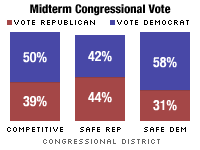
Let us first examine a series of facts, such as who conducted the poll, who it was sponsored by, why and how and when was this poll taken.
People-press poll reports that Democrats hold a double digit lead in competitive districts. Pew Research Center, an independent opinion research group, part of Princeton Research Associates is sponsored by the Pew Charitable Trusts. Surveys are one of the seven projects that make up the Research Center with the purpose of evaluating ideas on the media and public policy through public opinion research; the information produced is available at no charge.
Princeton Research Associates conducted this poll between October 17-22, 2006 on 2,006 adults, 18 years or older. The Associates attests with 95% confidence, that the error attributable to sampling is plus or minus 2.5 percentage points, and 3 % based on registered voters.
This is standard and acceptable in terms of margin of error, and so is a 95% confidence level and the organization behind the poll seems hardly biased or in it for partisan purposes. If this poll is accurate, it could suggest a number of very valuable pieces of information and with about a week to go to the midterm elections, knowing who is going to win the election is very significant to political leaders, journalists, scholars, and public interest organizations.
However, even if a poll is conducted scientifically it is only valid to a certain extent. Any given poll can be off by fifteen percent, and one has no way of knowing of this particular poll is part of that 5% an dis producing highly inaccurate results. In addition, polls can only be used to reflect large shifts in public opinion, like double digit changes, but by no means capable of measuring the tiny nuances and subtle changes among potential voters. These seemingly small percentages can be highly significant when measuring public opinion with issues that the nation tends to be close to equally split upon- although here it is not the case-it would then be almost impossible to accurately predict the actual state of public opinion. However, poll results don’t usually provide this valuable piece of information.
Public opinion also tends to highly volatile but as volatile as public opinion can be a lot of the fluctuations can be attributed to the way a specific poll is conducted.
For instance, the time of day, the days of the weeks are seemingly innocuous factors but they can create huge discrepancies between one poll results. (Thursday through Saturday is when young adults tend to be out partying or clubbing, and recent trends indicate they tend to vote Democratic.) With any given poll, no matter how scientific there are always barriers taht can obscure results. Factors such as language comprehension, the tendency of people not to respond they don’t know, and the fact that most people don’t have a real opinion on a given issue(and actually may form their opinion based on the way the question was asked) aren't really taken into account. There is an element of people wanting to provide the more “popular” answer, and not professing support for a losing candidate.
Even if public opinion was reflected upon in the poll, it is by no means indicative what the voting results will be. Many pollsters have different definitions of “likely voters” and even if it was more standardized they can still never accurately predict who will vote. A series of factors varying from weather conditions and other random factors can have an enormous impact on people’s individual decision whether to vote or not. In addition newly registered voters must be accounted for in the pollster’s assessment of “likely voters” but it is unclear who from the registered 18-21 age group is actually going to vote. There is also evidence of growing voter cynicism; this overall dissatisfaction may stem from a series of factors such as the pervasiveness of ridiculous campaign ads, negative media coverage, too much mention of scandals and corruption etc, and so although they may have professed support for a particular party or candidate they may end up staying home. Another important thing to note is that in this poll, people are being asked to profess their support for a one party over another, not for a specific candidate. Ever heard of the notorious love-hate relationship people have with congress? So while they may be strongly dissatisfied with a party overall, they may vote for the individual candidate anyway.
So in reality you can’t accurately conclude much from a poll. It is hardly a systematic and scientific way of attaining information, and in order really draw a valid conclusion the evidence must be absolutely precise. So, the only thing you can really conclude from this poll, is that the two thousand people or more who were polled responded in a way that seems to favor the Democratic party.
While it is commonly accepted that unscientific polling does not yield any valid results and is strictly for entertainment purposes, people’s opinion of the validity of professionally done scientific polling has hardly reached consensus. In fact, there is much individual ambivalence over the matter. Many people, on the one hand, are very cynical, verbally acknowledging the notorious inconclusiveness of poll results but at the same time seem to be infatuated with what the polls seem to indicate/predict. This holds particularly true with politicians, for whom public opinion is vital (think President Bush- claiming to have no faith in the authenticity of polls, but on the other hand having someone like Karl Rove around who tends have a “voracious appetite” for poll results.)
What is it about polls that makes them so controversial?
Take the following poll report:
"Democrats Hold Double Digit Lead in Competitive Districts. "
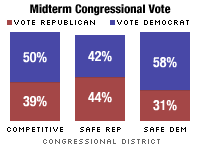
Let us first examine a series of facts, such as who conducted the poll, who it was sponsored by, why and how and when was this poll taken.
People-press poll reports that Democrats hold a double digit lead in competitive districts. Pew Research Center, an independent opinion research group, part of Princeton Research Associates is sponsored by the Pew Charitable Trusts. Surveys are one of the seven projects that make up the Research Center with the purpose of evaluating ideas on the media and public policy through public opinion research; the information produced is available at no charge.
Princeton Research Associates conducted this poll between October 17-22, 2006 on 2,006 adults, 18 years or older. The Associates attests with 95% confidence, that the error attributable to sampling is plus or minus 2.5 percentage points, and 3 % based on registered voters.
This is standard and acceptable in terms of margin of error, and so is a 95% confidence level and the organization behind the poll seems hardly biased or in it for partisan purposes. If this poll is accurate, it could suggest a number of very valuable pieces of information and with about a week to go to the midterm elections, knowing who is going to win the election is very significant to political leaders, journalists, scholars, and public interest organizations.
However, even if a poll is conducted scientifically it is only valid to a certain extent. Any given poll can be off by fifteen percent, and one has no way of knowing of this particular poll is part of that 5% an dis producing highly inaccurate results. In addition, polls can only be used to reflect large shifts in public opinion, like double digit changes, but by no means capable of measuring the tiny nuances and subtle changes among potential voters. These seemingly small percentages can be highly significant when measuring public opinion with issues that the nation tends to be close to equally split upon- although here it is not the case-it would then be almost impossible to accurately predict the actual state of public opinion. However, poll results don’t usually provide this valuable piece of information.
Public opinion also tends to highly volatile but as volatile as public opinion can be a lot of the fluctuations can be attributed to the way a specific poll is conducted.
For instance, the time of day, the days of the weeks are seemingly innocuous factors but they can create huge discrepancies between one poll results. (Thursday through Saturday is when young adults tend to be out partying or clubbing, and recent trends indicate they tend to vote Democratic.) With any given poll, no matter how scientific there are always barriers taht can obscure results. Factors such as language comprehension, the tendency of people not to respond they don’t know, and the fact that most people don’t have a real opinion on a given issue(and actually may form their opinion based on the way the question was asked) aren't really taken into account. There is an element of people wanting to provide the more “popular” answer, and not professing support for a losing candidate.
Even if public opinion was reflected upon in the poll, it is by no means indicative what the voting results will be. Many pollsters have different definitions of “likely voters” and even if it was more standardized they can still never accurately predict who will vote. A series of factors varying from weather conditions and other random factors can have an enormous impact on people’s individual decision whether to vote or not. In addition newly registered voters must be accounted for in the pollster’s assessment of “likely voters” but it is unclear who from the registered 18-21 age group is actually going to vote. There is also evidence of growing voter cynicism; this overall dissatisfaction may stem from a series of factors such as the pervasiveness of ridiculous campaign ads, negative media coverage, too much mention of scandals and corruption etc, and so although they may have professed support for a particular party or candidate they may end up staying home. Another important thing to note is that in this poll, people are being asked to profess their support for a one party over another, not for a specific candidate. Ever heard of the notorious love-hate relationship people have with congress? So while they may be strongly dissatisfied with a party overall, they may vote for the individual candidate anyway.
So in reality you can’t accurately conclude much from a poll. It is hardly a systematic and scientific way of attaining information, and in order really draw a valid conclusion the evidence must be absolutely precise. So, the only thing you can really conclude from this poll, is that the two thousand people or more who were polled responded in a way that seems to favor the Democratic party.
Wednesday, October 25, 2006
The Ruthless Butchering of the English Language…
Did anyone notice the oxymoron in my title? "Ruthless butchering of the English lanuage" is just the kind of prose that George Orwell would denounce. He talks about the dead metaphors and how the “newly invented metaphor assist thought by evoking a visual image” (read George Orwell's "Politics and Speech", 1946 in full) Orwell criticizes different aspects that he feels are being misused within the English language, and how overall the language is in a decadent state.
“The whole tendency of modern prose is away from concreteness” I couldn’t agree more with the statement. Being able to effectively manipulate the English language seems to be a notorious but essential characteristic of a politician. Knowing how to effectively deliver a speech, respond to questions in a way that is least revealing, say a lot but about nothing, take a stand on highly controversial issue while sound neutral, as not to ostracize any segment of supporters, know how to effectively conjure images in people’s minds, and emotionally stir them so they will share the speaker’s passion or zeal… for a politician these skills are priceless. Sadly, the public is often swayed people by the eloquent, colorful speeches that say nothing but are replete with vivid metaphors and elegant rhetoric. A miscalculation, a careless phrasing or a poor choice of words can prove catastrophic for someone in a leadership position.
Bush made a serious error in a statement in 2003. To quote from USA Today “There are some who feel that the the conditions are such that they can attack us there. My answer is bring them on," Bush said. "We've got the force necessary to deal with the security situation." He hit big trouble when he underestimated the potential of terrorism activity and the success they’d have in effectively killing so many Americans troops. Such are the dangers of speech. “White House spokesman Ari Fleischer said Bush's combative tone was not meant to invite attacks on Americans.”I think what the president was expressing there is his confidence in the men and women of the military to handle the military mission they still remain in the middle of," Fleischer said.
But Bush was criticized as "irresponsible and insightful." …"I am shaking my head in disbelief," Lautenberg said. "When I served in the Army in Europe during World War II, I never heard any military commander — let alone the commander in chief — invite enemies to attack U.S. troops."
Rep. Dick Gephardt, D-Mo., said, "I have a message for the president: enough of the phony, macho rhetoric
Government officials place strong emphasis on choice words particularly when they are trying to gain support of a cause effectively.
“The word Fascism has now no meaning except in so far as it signifies "something not desirable.”…“Islamic Fascism” sound familiar? “Weapons of mass destruction”, “bring freedom and democracy” are additional phrases coined by this government to in attempt to build a network of support for an unpopular war. It is government propaganda. Perhaps it is a more subtle method, but it is a highly effective; the phrases coined by the government tend to stick around for a long time.
“Democracy…ooo pick me!", Pres. of Venezuela (What he really meant to say)
“It is almost universally felt that when we call a country democratic we are praising it: consequently the defenders of every kind of regime claim that it is a democracy, and fear that they might have to stop using that word if it were tied down to any one meaning.”(-George Orwell)
Written over fifty years ago but oh so relevant today; at an era when the world has been overly simplified and depicted in shades of black and white with very little grey, countries are determined to be categorized under the “good” rather than the “evil”, and have their regime called a “democracy” rather than a “tyranny”. Regimes know that being characterized with these negative terminologies will alienate other countries and make it difficult for them to be successful in foreign policy making.
The President of Venezuela in an interview with TIME magazine actually tried to stick in the word democracy and make the case for his having a tolerable regime. He emphasized his allowance of voiced government opposition and the prevalence of it in his country. The humor of associating democracy with his regime is immense, but yet attempting to cast his regime in a better light he managed to stick the word "democracy" into his rhetoric.
Did anyone notice the oxymoron in my title? "Ruthless butchering of the English lanuage" is just the kind of prose that George Orwell would denounce. He talks about the dead metaphors and how the “newly invented metaphor assist thought by evoking a visual image” (read George Orwell's "Politics and Speech", 1946 in full) Orwell criticizes different aspects that he feels are being misused within the English language, and how overall the language is in a decadent state.
“The whole tendency of modern prose is away from concreteness” I couldn’t agree more with the statement. Being able to effectively manipulate the English language seems to be a notorious but essential characteristic of a politician. Knowing how to effectively deliver a speech, respond to questions in a way that is least revealing, say a lot but about nothing, take a stand on highly controversial issue while sound neutral, as not to ostracize any segment of supporters, know how to effectively conjure images in people’s minds, and emotionally stir them so they will share the speaker’s passion or zeal… for a politician these skills are priceless. Sadly, the public is often swayed people by the eloquent, colorful speeches that say nothing but are replete with vivid metaphors and elegant rhetoric. A miscalculation, a careless phrasing or a poor choice of words can prove catastrophic for someone in a leadership position.
Bush made a serious error in a statement in 2003. To quote from USA Today “There are some who feel that the the conditions are such that they can attack us there. My answer is bring them on," Bush said. "We've got the force necessary to deal with the security situation." He hit big trouble when he underestimated the potential of terrorism activity and the success they’d have in effectively killing so many Americans troops. Such are the dangers of speech. “White House spokesman Ari Fleischer said Bush's combative tone was not meant to invite attacks on Americans.”I think what the president was expressing there is his confidence in the men and women of the military to handle the military mission they still remain in the middle of," Fleischer said.
But Bush was criticized as "irresponsible and insightful." …"I am shaking my head in disbelief," Lautenberg said. "When I served in the Army in Europe during World War II, I never heard any military commander — let alone the commander in chief — invite enemies to attack U.S. troops."
Rep. Dick Gephardt, D-Mo., said, "I have a message for the president: enough of the phony, macho rhetoric
Government officials place strong emphasis on choice words particularly when they are trying to gain support of a cause effectively.
“The word Fascism has now no meaning except in so far as it signifies "something not desirable.”…“Islamic Fascism” sound familiar? “Weapons of mass destruction”, “bring freedom and democracy” are additional phrases coined by this government to in attempt to build a network of support for an unpopular war. It is government propaganda. Perhaps it is a more subtle method, but it is a highly effective; the phrases coined by the government tend to stick around for a long time.
“Democracy…ooo pick me!", Pres. of Venezuela (What he really meant to say)
“It is almost universally felt that when we call a country democratic we are praising it: consequently the defenders of every kind of regime claim that it is a democracy, and fear that they might have to stop using that word if it were tied down to any one meaning.”(-George Orwell)
Written over fifty years ago but oh so relevant today; at an era when the world has been overly simplified and depicted in shades of black and white with very little grey, countries are determined to be categorized under the “good” rather than the “evil”, and have their regime called a “democracy” rather than a “tyranny”. Regimes know that being characterized with these negative terminologies will alienate other countries and make it difficult for them to be successful in foreign policy making.
The President of Venezuela in an interview with TIME magazine actually tried to stick in the word democracy and make the case for his having a tolerable regime. He emphasized his allowance of voiced government opposition and the prevalence of it in his country. The humor of associating democracy with his regime is immense, but yet attempting to cast his regime in a better light he managed to stick the word "democracy" into his rhetoric.
Monday, October 23, 2006
Mainstream Media and New Media: Is there a difference?
The mainstream media is plagued with a series of issues such as hyper commercialism, dominating corporate powers, and a lack of healthy competition. Rather than these problems being solely based on the profit-driven nature of the market system, the current nature of the media market can be seen as a result of explicit government polices, regulations and subsidies that intertwine with corporate interests. This multitude of problems engulfing the media institution is not dealt with adequately by the government sponsored agency: the FCC. Many people would like to see significant changes implemented in the media system, if only this notion was an economic and political possibility.
Changes in media communications are constantly evolving, as technological innovations are being formed to feed the increasingly great demand for advancements for communication technologies within the US military. Thus the US government provides a strong innovative incentive since it the primary market for developments. Eventually it turns over to the new designs to the free market and allowing for commercial interests. The discovery of radio broadcasting, invention of the Internet and design of satellite communication were all sponsored by the US government.
Many have predicted that ultimately these new technologies will eliminate the major problems that engulf the modem media system, such as media ownership, and ultimately it will be the long term answer to the political and commercial issues permeating mainstream media
Clearly, the emergence of the Internet as a primary means of gathering news and information will have an effect upon journalism and entertainment, but whether the idea of it being independent of the series of issues plaguing the media system, is overly optimistic. Internet and technologies seem to be developing to benefit corporate interests as government policies to decide issues such as the role and nature of advertising, privacy protection, and application of copyright laws, tend to be very susceptible to these commercial pressures and the growing and merging of the institutions will only intensify its susceptibility.
The Internet allows large quantities of information to be delivered instantaneously, at low cost to people around the world. This makes it an appealing medium for advertisers, who seek to target the greatest number of people, in the shortest amount of time, and for the lowest cost. Campaign ads for government officials, has even caught onto the internet, not underestimating the prominence of facebook.com in a college student’s life. Congressional campaigners in 2006 election are actually using the WebPages to advertise and obtain support in the social cyber world.
Laws and standards have been set and developed by the government to govern the commercial world in the internet, and “protect” the consumer (see Advertising and Marketing on the Internet: Rules of the Road) But the pervasiveness of spam, popups, and viruses is evidence of the difficulties the government encounters in effectively policing the content of the internet traffic.
Unfortunately the idea of the Internet began a purged, cleansified and commercial free safe haven seems utopian at best. What is displayed onscreen at main internet sites such as Yahoo, Google, Amazon, or EBay is heavily planned and orchestrated by commercial interests. As long as material pursuits continue to exist and profit incentives remain, advertising revenues will be indispensable to companies and organizations on the Internet
However, one important distinction between the New Media and Mainstream media, is the News Media-the Internet provides endless sources of news and information, not allowing for the dominance of one particular news industry; conservatives, liberal, radicals and other political groups benefit from the variety of information available. In this aspect the Internet is unprecedented and extremely beneficial in providing information for special interest groups and allowing for the allowing existence of organizations that would otherwise be nonexistent in mainstream media because of their lack of capital.
The mainstream media is plagued with a series of issues such as hyper commercialism, dominating corporate powers, and a lack of healthy competition. Rather than these problems being solely based on the profit-driven nature of the market system, the current nature of the media market can be seen as a result of explicit government polices, regulations and subsidies that intertwine with corporate interests. This multitude of problems engulfing the media institution is not dealt with adequately by the government sponsored agency: the FCC. Many people would like to see significant changes implemented in the media system, if only this notion was an economic and political possibility.
Changes in media communications are constantly evolving, as technological innovations are being formed to feed the increasingly great demand for advancements for communication technologies within the US military. Thus the US government provides a strong innovative incentive since it the primary market for developments. Eventually it turns over to the new designs to the free market and allowing for commercial interests. The discovery of radio broadcasting, invention of the Internet and design of satellite communication were all sponsored by the US government.
Many have predicted that ultimately these new technologies will eliminate the major problems that engulf the modem media system, such as media ownership, and ultimately it will be the long term answer to the political and commercial issues permeating mainstream media
Clearly, the emergence of the Internet as a primary means of gathering news and information will have an effect upon journalism and entertainment, but whether the idea of it being independent of the series of issues plaguing the media system, is overly optimistic. Internet and technologies seem to be developing to benefit corporate interests as government policies to decide issues such as the role and nature of advertising, privacy protection, and application of copyright laws, tend to be very susceptible to these commercial pressures and the growing and merging of the institutions will only intensify its susceptibility.
The Internet allows large quantities of information to be delivered instantaneously, at low cost to people around the world. This makes it an appealing medium for advertisers, who seek to target the greatest number of people, in the shortest amount of time, and for the lowest cost. Campaign ads for government officials, has even caught onto the internet, not underestimating the prominence of facebook.com in a college student’s life. Congressional campaigners in 2006 election are actually using the WebPages to advertise and obtain support in the social cyber world.
Laws and standards have been set and developed by the government to govern the commercial world in the internet, and “protect” the consumer (see Advertising and Marketing on the Internet: Rules of the Road) But the pervasiveness of spam, popups, and viruses is evidence of the difficulties the government encounters in effectively policing the content of the internet traffic.
Unfortunately the idea of the Internet began a purged, cleansified and commercial free safe haven seems utopian at best. What is displayed onscreen at main internet sites such as Yahoo, Google, Amazon, or EBay is heavily planned and orchestrated by commercial interests. As long as material pursuits continue to exist and profit incentives remain, advertising revenues will be indispensable to companies and organizations on the Internet
However, one important distinction between the New Media and Mainstream media, is the News Media-the Internet provides endless sources of news and information, not allowing for the dominance of one particular news industry; conservatives, liberal, radicals and other political groups benefit from the variety of information available. In this aspect the Internet is unprecedented and extremely beneficial in providing information for special interest groups and allowing for the allowing existence of organizations that would otherwise be nonexistent in mainstream media because of their lack of capital.
Monday, October 09, 2006
(connects to previous post)
Republicans: Hold Your Nose and Vote…
Republicans are suffering the greatest repercussions as they have come across as hypocritical individuals, championing themselves as the party in favor of family values and yet failing to adequately deal with scandals within their own party. The timing of this incident, combined with the backdrop of the disaster of the war in Iraq doesn’t make the future look to bright for Republicans. Maybe they should be catering the following message: hold your nose and vote.
The media has been treating the Mark Foley sex scandal as the single underlying factor in this election. While I do not wish to condone the matter, or try to mitigate it, I think that it’s important that citizens focus on selecting candidates who will promote values that they support in legislation on defense, tax cuts, the environment, economy etc, and not allow this one incident to undermine the eligibility of all Republican candidates. Selecting another party’s candidate on their basis of the claim of a “higher standard of morality and ethics” is naive. Democrats have had their share of scandals and corruption, and have not necessarily dealt with them any better. Representative Gerry E. Studds, Democrat of Massachusetts who became embroiled in a sex scandal is just one example.
Anyone with a basic superficial glance should be able to gather that the Democrats are using this “clean up the senate” business as a political gamble to win congressional majority and not necessarily because their party is going to be any “cleaner”.
Thus my point here isn’t to defend the Republican Party, just to say that crooked politicians come in all sizes, shapes and forms. Congress is overall corrupt and sleazy, and switching parties isn’t going provide any long term solution.
Republicans: Hold Your Nose and Vote…
Republicans are suffering the greatest repercussions as they have come across as hypocritical individuals, championing themselves as the party in favor of family values and yet failing to adequately deal with scandals within their own party. The timing of this incident, combined with the backdrop of the disaster of the war in Iraq doesn’t make the future look to bright for Republicans. Maybe they should be catering the following message: hold your nose and vote.
The media has been treating the Mark Foley sex scandal as the single underlying factor in this election. While I do not wish to condone the matter, or try to mitigate it, I think that it’s important that citizens focus on selecting candidates who will promote values that they support in legislation on defense, tax cuts, the environment, economy etc, and not allow this one incident to undermine the eligibility of all Republican candidates. Selecting another party’s candidate on their basis of the claim of a “higher standard of morality and ethics” is naive. Democrats have had their share of scandals and corruption, and have not necessarily dealt with them any better. Representative Gerry E. Studds, Democrat of Massachusetts who became embroiled in a sex scandal is just one example.
Anyone with a basic superficial glance should be able to gather that the Democrats are using this “clean up the senate” business as a political gamble to win congressional majority and not necessarily because their party is going to be any “cleaner”.
Thus my point here isn’t to defend the Republican Party, just to say that crooked politicians come in all sizes, shapes and forms. Congress is overall corrupt and sleazy, and switching parties isn’t going provide any long term solution.
Due to blog troubleshooting I’ve encountered with the following post, it may be slightly outdated:
Recent Headlines: Evidence of more Tabloid Journalism or of US Congress Getting Sleazier?
Leighly notes in Mass Media and Politics that while coverage of Congress has decreased over the past decade, the news that is mentioned has become increasingly more negative. She presents a study, published by S. Robert Lichter and Daniel R Amundson that indicated a 12% increase in negative coverage of both parties in Congress between the years 1972 and 1994.
Leighly speculates that the negative shift of congressional news coverage either reflects substantial changes of behavior within members of Congress, or is due to a shift in the way “newsworthiness” is being determined by media industries. Originally, upon contemplating this issue, I favored the former explanation, as it that seemed more in line with the profit seeking model, and the latter explanation I saw as weak since corruption has plagued Congress since the dawn of its existence.
Unfortunately, there is an undeniable pervasive effect of tabloid journalism. The general focus of the media on sex, scandal and corruption, translates into extensive coverage of the corruption and scandals that occur in Congress, and a lack of sufficient coverage over significant developments in legislation or of important issues that are being deliberated. Thus, by presenting only the headlines that would receive the most attention, comes the consequence of widespread ignorance of politics among citizens, typically more familiar with the names of the animated Simpson family than the names of the Supreme Court Justices.
During elections when educating the public is especially pertinent, as I mentioned in my previous blog, the media’s focus is on the “game” or “horserace”, who is ahead or behind in the logistics and strategy, up or down in the polls and providing completely unsubstantial and useless information that not only fails to aid voters in their choosing a candidate, but results in greater voter cynicism and less turnout on election day. (See how the coverage of the congressional race has shifted even more towards the “game” and “horserace” after the Foley sex scandal: at USATODAY.com - Race for Senate control tightens, and in The NY Times In House Races, More G.O.P. Seats Seen at Risk as well as The Fix -- Washington post,)
At the same time as the media seems to fail in educating citizens of essential political fact, its recent focus on the scandals and allegation against congressmen have brought to light the sordid state our government it is in. Overall, rather than congress being portrayed as the main deliberation policymaking body of the federal government that it has been conveyed as a swamp that houses sleazy corrupt individuals, power and money hungry, constantly engaged in bolstering their popularity, using whatever means necessary to achieve their political goals. Sadly, this portrayal reflects reality; pedophiles, hypocrites, liars, acrimonious racists, swindlers, and embezzlers just name a few. Therefore, we cannot only cite journalistic tendencies to account for the increasingly negative coverage of Congress.
The Mark Foley incident has been especially grotesque, and the availability of web technology has made the story especially powerful with Bryan Ross’s broadcasting (see ABC News clip) actual conversations that took place between the Senator and a male page, via instant message and as Newsweek puts it, “while congressmen caught in sex scandal is nothing new, the way the story broke shows the power of web technology to influence politics”
However, the amount of corruption that is plaguing our Senate and House lately seems a bit over the top and even unprecedented. The Mark Foley scandal has left many more cynical of our legislative body than ever. The people running our country, our Federal government lack basic morals and ethics.
Recent Headlines: Evidence of more Tabloid Journalism or of US Congress Getting Sleazier?
Leighly notes in Mass Media and Politics that while coverage of Congress has decreased over the past decade, the news that is mentioned has become increasingly more negative. She presents a study, published by S. Robert Lichter and Daniel R Amundson that indicated a 12% increase in negative coverage of both parties in Congress between the years 1972 and 1994.
Leighly speculates that the negative shift of congressional news coverage either reflects substantial changes of behavior within members of Congress, or is due to a shift in the way “newsworthiness” is being determined by media industries. Originally, upon contemplating this issue, I favored the former explanation, as it that seemed more in line with the profit seeking model, and the latter explanation I saw as weak since corruption has plagued Congress since the dawn of its existence.
Unfortunately, there is an undeniable pervasive effect of tabloid journalism. The general focus of the media on sex, scandal and corruption, translates into extensive coverage of the corruption and scandals that occur in Congress, and a lack of sufficient coverage over significant developments in legislation or of important issues that are being deliberated. Thus, by presenting only the headlines that would receive the most attention, comes the consequence of widespread ignorance of politics among citizens, typically more familiar with the names of the animated Simpson family than the names of the Supreme Court Justices.
During elections when educating the public is especially pertinent, as I mentioned in my previous blog, the media’s focus is on the “game” or “horserace”, who is ahead or behind in the logistics and strategy, up or down in the polls and providing completely unsubstantial and useless information that not only fails to aid voters in their choosing a candidate, but results in greater voter cynicism and less turnout on election day. (See how the coverage of the congressional race has shifted even more towards the “game” and “horserace” after the Foley sex scandal: at USATODAY.com - Race for Senate control tightens, and in The NY Times In House Races, More G.O.P. Seats Seen at Risk as well as The Fix -- Washington post,)
At the same time as the media seems to fail in educating citizens of essential political fact, its recent focus on the scandals and allegation against congressmen have brought to light the sordid state our government it is in. Overall, rather than congress being portrayed as the main deliberation policymaking body of the federal government that it has been conveyed as a swamp that houses sleazy corrupt individuals, power and money hungry, constantly engaged in bolstering their popularity, using whatever means necessary to achieve their political goals. Sadly, this portrayal reflects reality; pedophiles, hypocrites, liars, acrimonious racists, swindlers, and embezzlers just name a few. Therefore, we cannot only cite journalistic tendencies to account for the increasingly negative coverage of Congress.
The Mark Foley incident has been especially grotesque, and the availability of web technology has made the story especially powerful with Bryan Ross’s broadcasting (see ABC News clip) actual conversations that took place between the Senator and a male page, via instant message and as Newsweek puts it, “while congressmen caught in sex scandal is nothing new, the way the story broke shows the power of web technology to influence politics”
However, the amount of corruption that is plaguing our Senate and House lately seems a bit over the top and even unprecedented. The Mark Foley scandal has left many more cynical of our legislative body than ever. The people running our country, our Federal government lack basic morals and ethics.
Wednesday, September 27, 2006
State of Virginia: the Focal Point ?? In providing coverage for this year’s State Senate and House election campaign, during the past couple of weeks the media has seemed to almost focus extensively on one state: Virginia. This seems a bit absurd and there seems to be no reason for this, as we know that nationally Virginia has just as much significance as any other state.
Leighly explains, in chapter 8 of Mass Media & Politics, the tendency of the media to focus on the negative developments in campaign coverage. A study conducted by Thomas Patterson during the 1976 presidential contest indicated that the nonpresidential campaign coverage tended to focus primarily on details of the strategy and logistics behind the political battle, and who was ahead or behind in the campaign, known as the game or horserace. Instead of focusing more on the actual difference of agenda's in the candidates, and provide basic substansive information aboutthe candidates, the media emphasised major blunders or miscues that occured during campaigning.
This seemed to be precisely the case with Republican George Allen of Virginia.
Yesterday, the NY Times featured a front page article featuring the latest allegations regarding Senator Allen George. The article mentioned two former acquaintances of the Senator who had come forward to reveal George’s long of history of racial tendencies and brought various examples of the racially offensive comments he had made, such as his reason for moving to Virginia “because the blacks know their place.” The Times also mentioned a few people who had denied these accusations and come to his defense, such as his campaign advisor and former spouse. Overall the article put the Senator in a negative light, “until a few weeks ago, Mr. Allen appeared to have a solid advantage in his reelection campaign …but insinuations of racial insensitivity have hovered in the background of the Allen campaign ever since last spring” (referring to the New Republic reporting of his wearing a confederate flag pin in his yearbook picture).
The article briefly went through the string of incidents that occurred since the campaign, that had given him a lot of negative media coverage, beginning with his first campaign appearance where he referred to a young democratic college student, of Indian descent with a racially offense term as a “macaca”.
AOL news Senator Faces More Allegations of Racial Slurs on the main welcome screen provided a similar story as well, although it was more comprehensive in its featuring a greater number of people who come forward to deny the validity of the allegations, such as his college roommate.
In addition, the three major news magazines: Newsweek, Time, US News & World report have given extensive coverage to the Virginia campaign, mostly describing the negative allegations and blunders of rep. Senator George Allen.
This week’s issue (October 2nd) of Time magazine, featured George Allen as well. Joe Klein’s In The Arena column titled “Iraq? Who Cares! Say, Is Your Mom Jewish?” The article focused on Webb’s anti-war views and international policy in general in the War on Terror, but highlighted Allen’s admitting of his Jewish heritage “It was a fabulous political theatre…Allen squirming, craven and hegira from white hegira from white-bread Presbyterianism to the admission that his mother was a Sephardic Jew”
“We’ll stop including him in this column as he stops giving us material,” Time said humorously in the same issue when he once again made it to a side column that usually features a couple of non formal sentences or interesting anecdotes about developments within the government.
However, even if the macaca incident could be used to explain the extensive media coverage Senator George Allen has been receiving, it wouldn’t explain why his Democratic opponent for the US senate Jim Webb has been receiving extensive coverage as well.
Newsweek’s September 18th issue devoted four and half pages discussing the Virginia candidates, focusing on Jim Webb, such as his services to country in Vietnam, and his adamant policies against the war in Iraq that he had right from the beginning seemed the prime forces. “Webb is not a normal politician. He is a warrior with the medals and wounds to prove it.” The overage of Webb seemed rather positive and the writer portrayed him also as someone, with strong moral convictions “soldiers do their duty, regardless if whether the politicians who lead them into wars are right or wrong” who seemed to be above political stereotypes and lowly tactics, but at the same time lacked the tact, and experience greatly needed in campaign speeches and debates. On the other hand the article characterized “GOP senator George Allen Jr.,” as someone who “plays the good-ole boy superpatriot…but next to a hardened combat veteran like Webb, he can seem like a tough guy wanna-be.”
However, minimal coverage has been given to any other state senators. The NY Times yesterday’s metro section briefly mentioned in a few short sentences Florida republican Katherine Harris, (the descriptions paled in comparison to the amount of content featured regarding Virginia senator George Allen) and the September 25th issue of US News & World report had a brief article mentioning the Montana candidates for Senate. Other than these few exceptions that the media has tended to focus on the national issues and has seldom gone up close, profiling the candidates like it did with Virginia , with too many other states.
Evidently the thirty year old study, Paterson produced that indicating that electoral coverage is marked by an emphasis on important conflicts and strategies that occur within the campaigning and its focusing on the negative occurrences and political slip-ups still applies today. Obviously the media has failed to live up ot the expectations of the public advocate model. By focusing on the types of issues illustrated above, and failing to provide the basic political issues of the day, the media seems to be falling in line with the profit-seeker model; it focuses on entertainment values in order to attempt to glean the largest audiece possible.
Leighly explains, in chapter 8 of Mass Media & Politics, the tendency of the media to focus on the negative developments in campaign coverage. A study conducted by Thomas Patterson during the 1976 presidential contest indicated that the nonpresidential campaign coverage tended to focus primarily on details of the strategy and logistics behind the political battle, and who was ahead or behind in the campaign, known as the game or horserace. Instead of focusing more on the actual difference of agenda's in the candidates, and provide basic substansive information aboutthe candidates, the media emphasised major blunders or miscues that occured during campaigning.
This seemed to be precisely the case with Republican George Allen of Virginia.
Yesterday, the NY Times featured a front page article featuring the latest allegations regarding Senator Allen George. The article mentioned two former acquaintances of the Senator who had come forward to reveal George’s long of history of racial tendencies and brought various examples of the racially offensive comments he had made, such as his reason for moving to Virginia “because the blacks know their place.” The Times also mentioned a few people who had denied these accusations and come to his defense, such as his campaign advisor and former spouse. Overall the article put the Senator in a negative light, “until a few weeks ago, Mr. Allen appeared to have a solid advantage in his reelection campaign …but insinuations of racial insensitivity have hovered in the background of the Allen campaign ever since last spring” (referring to the New Republic reporting of his wearing a confederate flag pin in his yearbook picture).
The article briefly went through the string of incidents that occurred since the campaign, that had given him a lot of negative media coverage, beginning with his first campaign appearance where he referred to a young democratic college student, of Indian descent with a racially offense term as a “macaca”.
AOL news Senator Faces More Allegations of Racial Slurs on the main welcome screen provided a similar story as well, although it was more comprehensive in its featuring a greater number of people who come forward to deny the validity of the allegations, such as his college roommate.
In addition, the three major news magazines: Newsweek, Time, US News & World report have given extensive coverage to the Virginia campaign, mostly describing the negative allegations and blunders of rep. Senator George Allen.
This week’s issue (October 2nd) of Time magazine, featured George Allen as well. Joe Klein’s In The Arena column titled “Iraq? Who Cares! Say, Is Your Mom Jewish?” The article focused on Webb’s anti-war views and international policy in general in the War on Terror, but highlighted Allen’s admitting of his Jewish heritage “It was a fabulous political theatre…Allen squirming, craven and hegira from white hegira from white-bread Presbyterianism to the admission that his mother was a Sephardic Jew”
“We’ll stop including him in this column as he stops giving us material,” Time said humorously in the same issue when he once again made it to a side column that usually features a couple of non formal sentences or interesting anecdotes about developments within the government.
However, even if the macaca incident could be used to explain the extensive media coverage Senator George Allen has been receiving, it wouldn’t explain why his Democratic opponent for the US senate Jim Webb has been receiving extensive coverage as well.
Newsweek’s September 18th issue devoted four and half pages discussing the Virginia candidates, focusing on Jim Webb, such as his services to country in Vietnam, and his adamant policies against the war in Iraq that he had right from the beginning seemed the prime forces. “Webb is not a normal politician. He is a warrior with the medals and wounds to prove it.” The overage of Webb seemed rather positive and the writer portrayed him also as someone, with strong moral convictions “soldiers do their duty, regardless if whether the politicians who lead them into wars are right or wrong” who seemed to be above political stereotypes and lowly tactics, but at the same time lacked the tact, and experience greatly needed in campaign speeches and debates. On the other hand the article characterized “GOP senator George Allen Jr.,” as someone who “plays the good-ole boy superpatriot…but next to a hardened combat veteran like Webb, he can seem like a tough guy wanna-be.”
However, minimal coverage has been given to any other state senators. The NY Times yesterday’s metro section briefly mentioned in a few short sentences Florida republican Katherine Harris, (the descriptions paled in comparison to the amount of content featured regarding Virginia senator George Allen) and the September 25th issue of US News & World report had a brief article mentioning the Montana candidates for Senate. Other than these few exceptions that the media has tended to focus on the national issues and has seldom gone up close, profiling the candidates like it did with Virginia , with too many other states.
Evidently the thirty year old study, Paterson produced that indicating that electoral coverage is marked by an emphasis on important conflicts and strategies that occur within the campaigning and its focusing on the negative occurrences and political slip-ups still applies today. Obviously the media has failed to live up ot the expectations of the public advocate model. By focusing on the types of issues illustrated above, and failing to provide the basic political issues of the day, the media seems to be falling in line with the profit-seeker model; it focuses on entertainment values in order to attempt to glean the largest audiece possible.
Thursday, September 21, 2006
A few nights ago, I had the privilege of hearing Steven Aftergood, director of the FAS program on government secrecy, speak to us and explain the importance of reducing the extent of secrecy the government can extend within itself.
He brought various examples of instances where documents were withheld by the government and after their release it became obvious that the “secrets” they contained had long since expired and had no reason to remain classified. He mentioned that one of the oldest documents that until recently had remained “classified”, dated back to World War I era and its contents discussed the ingredients for lemon juice to be used as an invisible ink. He cited a few other old documents that had been under the “classified” status and had information that had either long since expired, or never should’ve been classified in the first place. In these examples, Aftergood clearly made the case for the government being a bit extreme in terms of determining what should remain classified, but failed here to provide valid reason for anyone to be mildly concerned with these practices unless, for instance they possessed a some curiosity to uncover obsolete war plans (because other wise why should anyone care that some antediluvian documents still remain classified?)
Aftergood also mentioned the numbers involved in protecting government secrecy that had starkly risen within the past five years (government officials, classified documents, spending etc.) This I don’t think calls for any great mystery solving or scrutiny; our nation is at war and must strengthen our defense and security industries in order to succeed.
Aftergood also referred to the document that contained the CIA’s briefing of the President a month prior to the 9/11, with “Bin Laden determined to strike in the US”, which remained classified up until 2005. He left it open to discussion whether publicizing the document could’ve actually prevented the attacks, but seemed to imply that it was classified for no good reason. I personally doubt the release of this document would have many any sort of difference. For one, it wouldn’t have gotten much coverage in the media even if it were released to the press. Prior to the attacks American’s had a very solid image of the US as a dominant and invincible superpower, and would’ve been very skeptical of the idea that some Islamic extremist is actually capable of carrying out attacks in American soil. Even today, after the attacks people have occurred, people still have a hard time believing that foreign radical Muslims actually succeeded in orchestrated these attacks (- evident in the numerous conspiracy theories circulating that claim that our own government arranged 9/11.) In addition, as a general practice the government doesn’t and shouldn’t release all details about imminent threats to our country and there are many valid reasons for this that we aren’t always aware of.
However, although have great faith in our government’s dedication to protect us and promote what’s beneficial for us, as far them having unlimited freedom in extending secrecy to whatever they wish in the intelligence agencies, I believe that can leave room for abuse and this is where our the system of the checks and balances needs to step in. Aftergood brought to light the potential for government to exploit the system by using the “classified” status to conceal documents that are controversial or could be politically damaging. One of the examples he cited was the prisoners of Abu Graib. Sadly the incident will be a scar in the US military history and the fact that the government officials attempted to conceal the story under pretenses of “sensitive” or “classified” only added to the notoriety of the scandal. Therefore, it is important that we have the right to request government information through the FIA law. “The Freedom of Information of Act” is helpful in terms of limiting government power because it obliges the officials to produce the requested document unless it is among the nine categories that are exempted.
However, some other examples Aftergood brought in, I did not see as sufficient reason to condemn or petition the government against their secrecy practices. Overall, he did not make a strong enough case for me to support his agenda, and at times I felt like he didn’t provide the full context or background of the information he presented. He definitely had an agenda and wanted to make an impression on our young valuable minds. However, I would like to give him credit for diplomatically addressing us, and responding to our questions in a candid friendly tolerant way.
He brought various examples of instances where documents were withheld by the government and after their release it became obvious that the “secrets” they contained had long since expired and had no reason to remain classified. He mentioned that one of the oldest documents that until recently had remained “classified”, dated back to World War I era and its contents discussed the ingredients for lemon juice to be used as an invisible ink. He cited a few other old documents that had been under the “classified” status and had information that had either long since expired, or never should’ve been classified in the first place. In these examples, Aftergood clearly made the case for the government being a bit extreme in terms of determining what should remain classified, but failed here to provide valid reason for anyone to be mildly concerned with these practices unless, for instance they possessed a some curiosity to uncover obsolete war plans (because other wise why should anyone care that some antediluvian documents still remain classified?)
Aftergood also mentioned the numbers involved in protecting government secrecy that had starkly risen within the past five years (government officials, classified documents, spending etc.) This I don’t think calls for any great mystery solving or scrutiny; our nation is at war and must strengthen our defense and security industries in order to succeed.
Aftergood also referred to the document that contained the CIA’s briefing of the President a month prior to the 9/11, with “Bin Laden determined to strike in the US”, which remained classified up until 2005. He left it open to discussion whether publicizing the document could’ve actually prevented the attacks, but seemed to imply that it was classified for no good reason. I personally doubt the release of this document would have many any sort of difference. For one, it wouldn’t have gotten much coverage in the media even if it were released to the press. Prior to the attacks American’s had a very solid image of the US as a dominant and invincible superpower, and would’ve been very skeptical of the idea that some Islamic extremist is actually capable of carrying out attacks in American soil. Even today, after the attacks people have occurred, people still have a hard time believing that foreign radical Muslims actually succeeded in orchestrated these attacks (- evident in the numerous conspiracy theories circulating that claim that our own government arranged 9/11.) In addition, as a general practice the government doesn’t and shouldn’t release all details about imminent threats to our country and there are many valid reasons for this that we aren’t always aware of.
However, although have great faith in our government’s dedication to protect us and promote what’s beneficial for us, as far them having unlimited freedom in extending secrecy to whatever they wish in the intelligence agencies, I believe that can leave room for abuse and this is where our the system of the checks and balances needs to step in. Aftergood brought to light the potential for government to exploit the system by using the “classified” status to conceal documents that are controversial or could be politically damaging. One of the examples he cited was the prisoners of Abu Graib. Sadly the incident will be a scar in the US military history and the fact that the government officials attempted to conceal the story under pretenses of “sensitive” or “classified” only added to the notoriety of the scandal. Therefore, it is important that we have the right to request government information through the FIA law. “The Freedom of Information of Act” is helpful in terms of limiting government power because it obliges the officials to produce the requested document unless it is among the nine categories that are exempted.
However, some other examples Aftergood brought in, I did not see as sufficient reason to condemn or petition the government against their secrecy practices. Overall, he did not make a strong enough case for me to support his agenda, and at times I felt like he didn’t provide the full context or background of the information he presented. He definitely had an agenda and wanted to make an impression on our young valuable minds. However, I would like to give him credit for diplomatically addressing us, and responding to our questions in a candid friendly tolerant way.
Tuesday, September 12, 2006
About the Bloggin' World
I came across an interesting blog today http://www.brendanloy.com/2006/09/911-conspiracy-theories-full-of-false-facts.html In this post the blogger summarized in a few short paragraphs why the 9/11 conspiracy theory is not based on fact, and is based on circumstantial and manipulated evidence, such as taking quotes out of context and arguments that could easily be refuted with counter evidence, and facts produced by scientific investigations.
The particular blogger who published his post gained a lot of fame through his post about hurricane Katrina, that evolved into the most number one ranked blog about the issue on the net. He was receiving as many as thirty thousand comments a day. Thus, it would make sense for his readers to have very high expectations for him as a blogger and probably would seek his opinion about other issues just because he argued and presented his opinion so adequately in the past.
Because he published his post only three short hoy=11
I came across an interesting blog today http://www.brendanloy.com/2006/09/911-conspiracy-theories-full-of-false-facts.html In this post the blogger summarized in a few short paragraphs why the 9/11 conspiracy theory is not based on fact, and is based on circumstantial and manipulated evidence, such as taking quotes out of context and arguments that could easily be refuted with counter evidence, and facts produced by scientific investigations.
The particular blogger who published his post gained a lot of fame through his post about hurricane Katrina, that evolved into the most number one ranked blog about the issue on the net. He was receiving as many as thirty thousand comments a day. Thus, it would make sense for his readers to have very high expectations for him as a blogger and probably would seek his opinion about other issues just because he argued and presented his opinion so adequately in the past.
Because he published his post only three short hoy=11
Monday, September 11, 2006
Congress, the Media, and Press Conferences
Members of Congress tend to view the media attention as essential for advancing their political careers. They feel that their popularity and electoral success heavily depends on positive press coverage. Thus, most political institutions have been redesigned to allow maximum media coverage by making them more accessible and convenient for reporters.
The media tends to focus primarily on the members of Congress who are in formal positions of leadership. Studies and analysis of stories featured in the Vanderbilt Television New Archive between 1872 and 1984 illustrated that leadership, extreme views, opposition to the president, scandal are all associated with increased coverage of government officials in the legislative body.
Government officials may attempt to publicize certain events, issues, or agendas that it feels is politically beneficial through press conferences, daily briefing (presidential usually) and other methods. Press conferences in general serve as a means for government officials to garner media attention easily, and portray a particular meaning or interpretation about events. Reporters find this type of news easy and cost effective to produce, and thus will attend these conferences. However, ultimately does the media fulfill its role in society as a linkage institution, that effectively communicates news of the government to the American people, or does it merely regurgitate back to the public what it has been strategically spoon-fed by government officials?
Let’s look closely at the following press conference. On September 5, 2006, Senate Democratic Leader Harry Reid of Nevada, Asst. Democratic Leader Dick Durbin of Illinois and other congressional Democrats arranged a press conference on global security in order to respond to President Bush’s speech on global terrorism, and demonstrate that despite the successes he has claimed, he has overwhelmingly failed in the war on terror, citing evidence such as the death toll in Iraq, the dwindling popularity of US worldwide, and the growth of terror networks around the globe. It served to formally introduce a report drafted by the Third Way, evaluating Bush success in the War on Terror.
General Wesley Clark, was the first one to speak after Senator Reid gave a brief introduction. Clark’s main focus was to highlight how the Bush administration and Republican leadership in Congress had failed in keeping America safe. He strongly emphasized the failures in Iraq, labeling its invasion as “a distraction from what we were trying to accomplish in Afghanistan” and “counterproductive in winning the War on Terror.” Clark also criticized the lack of diplomatic tactics used by the administration, saying that the real way to win the war is not by talking to tough about our enemies but by “strengthening relations with other countries …and talking to people you don't necessarily agree with” and criticized Bush’s failure to have direct talks with North Korea and Iran. He summarized by saying that the Bush administration was making America less safe, and a new leadership in Congress was much needed, declaring Democrats as far more suitable leaders “to curb the threat of nuclear proliferation”. The next series of speakers seemed to emphasize the same issues as Clark; Senator Carper, Senator Durbin and U.S. Representative Steny Hoyer all stressed Bush’s disastrous foreign policy, the administration’s failure in keeping the American people safe, and the debacles of the war in Iraq. Senator Thomas Carper tried to convey Democrats as the party that has always backed the war on terror and identified himself as someone who seeks bipartisan solutions but the Bush administration making this endeavor impossible.
Sharon Burke, member of Third Way, a group founded by Democrats who support gun control, and Director of a National Security Project spoke last and introduced a report titled “In the Neo Con: The Bush Defense Record by the Numbers.” Based on numerical evaluations of several factors ranging from the condition of American military, to the nuclear programs in Iran, and North Korea, she declared the report as revealing troubling numbers and that the evidence in the report did not “match the tough talk of the President” In the end when questions were taken, Reed carefully dismissed a question by a news reporter who began by saying “Senator Reid I was hoping you could expand on the”- possibly because he thought she might raise a question that would put him in an uncomfortable position, and thus responded by saying “lets take someone from the right for a change.” The following question was directed to Senator Carper asking him to explain how he would implement diplomatic tactics in dealing with tyrannical regimes, and ones that supported terrorism. Carper responded to this by referring to countries who were tyrannical but did were not necessarily allied with other belligerent regimes, and explained how we could use this to our advantage in fighting the war on terror. He also carefully tied in the mistake of the Bush administration in not using this method, and called it a “roadmap to war”. Someone asked Reid if he would call the administrations’ depiction of terrorism as a “scare tactic”, and Reid answered by bringing in Iraq.
The various questions that were raised seemed to have a common pattern in which they were addressed. Reid and Carper who answered most of the questions always managed to strategically tie in the failures of the administration and Iraq even if it had nothing to do with the question asked. This is a common tactic used by the government officials in press conferences whose goal is to convey a specific point even if it means reemphasizing it over and over again. In fact, throughout the conference the series of speakers merely restated what his predecessor had said. However, this didn’t strengthen their views but if anything the issues they raised began to lose their poignancy because they’d mentioned so many times. Also, although the conference was titled “global security” the absence of a single act of terrorism on American soil in five years was not acknowledged nor mentioned during any of the speeches since the essence of the conference was to shed the administration in negative light, and convince the public that new leadership was needed, and thus ultimately bolster enough support for a democratic majority party in congress. The speakers also failed to identify any other useful tactic that would be implemented, other than a more diplomatic approach in fighting the war.
Obviously, the nature of the meeting was for the Democrats to politically strengthen their parties agenda, like most conferences tend to be opportunities for, and gain support for a Democratic congressional majority, by listing convenient failures of the Republicans the Bush administration, or areas that they subjectively interpreted as failures.
Thus, by carefully selecting the information that will be presented and accentuated in a conference, as well as bringing these points in whatever questions are raised, is a method, politicians use to get the media to report what they deem politically beneficial.
Members of Congress tend to view the media attention as essential for advancing their political careers. They feel that their popularity and electoral success heavily depends on positive press coverage. Thus, most political institutions have been redesigned to allow maximum media coverage by making them more accessible and convenient for reporters.
The media tends to focus primarily on the members of Congress who are in formal positions of leadership. Studies and analysis of stories featured in the Vanderbilt Television New Archive between 1872 and 1984 illustrated that leadership, extreme views, opposition to the president, scandal are all associated with increased coverage of government officials in the legislative body.
Government officials may attempt to publicize certain events, issues, or agendas that it feels is politically beneficial through press conferences, daily briefing (presidential usually) and other methods. Press conferences in general serve as a means for government officials to garner media attention easily, and portray a particular meaning or interpretation about events. Reporters find this type of news easy and cost effective to produce, and thus will attend these conferences. However, ultimately does the media fulfill its role in society as a linkage institution, that effectively communicates news of the government to the American people, or does it merely regurgitate back to the public what it has been strategically spoon-fed by government officials?
Let’s look closely at the following press conference.
 On September 5, 2006, Senate Democratic Leader Harry Reid of Nevada, Asst. Democratic Leader Dick Durbin of Illinois and other congressional Democrats arranged a press conference on global security in order to respond to President Bush’s speech on global terrorism, and demonstrate that despite the successes he has claimed, he has overwhelmingly failed in the war on terror, citing evidence such as the death toll in Iraq, the dwindling popularity of US worldwide, and the growth of terror networks around the globe. It served to formally introduce a report drafted by the Third Way, evaluating Bush success in the War on Terror.
General Wesley Clark, was the first one to speak after Senator Reid gave a brief introduction. Clark’s main focus was to highlight how the Bush administration and Republican leadership in Congress had failed in keeping America safe. He strongly emphasized the failures in Iraq, labeling its invasion as “a distraction from what we were trying to accomplish in Afghanistan” and “counterproductive in winning the War on Terror.” Clark also criticized the lack of diplomatic tactics used by the administration, saying that the real way to win the war is not by talking to tough about our enemies but by “strengthening relations with other countries …and talking to people you don't necessarily agree with” and criticized Bush’s failure to have direct talks with North Korea and Iran. He summarized by saying that the Bush administration was making America less safe, and a new leadership in Congress was much needed, declaring Democrats as far more suitable leaders “to curb the threat of nuclear proliferation”. The next series of speakers seemed to emphasize the same issues as Clark; Senator Carper, Senator Durbin and U.S. Representative Steny Hoyer all stressed Bush’s disastrous foreign policy, the administration’s failure in keeping the American people safe, and the debacles of the war in Iraq. Senator Thomas Carper tried to convey Democrats as the party that has always backed the war on terror and identified himself as someone who seeks bipartisan solutions but the Bush administration making this endeavor impossible.
Sharon Burke, member of Third Way, a group founded by Democrats who support gun control, and Director of a National Security Project spoke last and introduced a report titled “In the Neo Con: The Bush Defense Record by the Numbers.” Based on numerical evaluations of several factors ranging from the condition of American military, to the nuclear programs in Iran, and North Korea, she declared the report as revealing troubling numbers and that the evidence in the report did not “match the tough talk of the President” In the end when questions were taken, Reed carefully dismissed a question by a news reporter who began by saying “Senator Reid I was hoping you could expand on the”- possibly because he thought she might raise a question that would put him in an uncomfortable position, and thus responded by saying “lets take someone from the right for a change.” The following question was directed to Senator Carper asking him to explain how he would implement diplomatic tactics in dealing with tyrannical regimes, and ones that supported terrorism. Carper responded to this by referring to countries who were tyrannical but did were not necessarily allied with other belligerent regimes, and explained how we could use this to our advantage in fighting the war on terror. He also carefully tied in the mistake of the Bush administration in not using this method, and called it a “roadmap to war”. Someone asked Reid if he would call the administrations’ depiction of terrorism as a “scare tactic”, and Reid answered by bringing in Iraq.
The various questions that were raised seemed to have a common pattern in which they were addressed. Reid and Carper who answered most of the questions always managed to strategically tie in the failures of the administration and Iraq even if it had nothing to do with the question asked. This is a common tactic used by the government officials in press conferences whose goal is to convey a specific point even if it means reemphasizing it over and over again. In fact, throughout the conference the series of speakers merely restated what his predecessor had said. However, this didn’t strengthen their views but if anything the issues they raised began to lose their poignancy because they’d mentioned so many times. Also, although the conference was titled “global security” the absence of a single act of terrorism on American soil in five years was not acknowledged nor mentioned during any of the speeches since the essence of the conference was to shed the administration in negative light, and convince the public that new leadership was needed, and thus ultimately bolster enough support for a democratic majority party in congress. The speakers also failed to identify any other useful tactic that would be implemented, other than a more diplomatic approach in fighting the war.
Obviously, the nature of the meeting was for the Democrats to politically strengthen their parties agenda, like most conferences tend to be opportunities for, and gain support for a Democratic congressional majority, by listing convenient failures of the Republicans the Bush administration, or areas that they subjectively interpreted as failures.
Thus, by carefully selecting the information that will be presented and accentuated in a conference, as well as bringing these points in whatever questions are raised, is a method, politicians use to get the media to report what they deem politically beneficial.
Wednesday, September 06, 2006
NETWORK, 1976
Network, features a harsh but justified look at the inner workings of the media industry. It reveals the pitfalls and shortcomings of television networks through shedding light on some of the corrupt individuals who form the backbone of the television networks.
The film focuses primarily on Howard Beale, played by Peter Finch, who is a veteran news anchorman for UBS-TV, and is fired because his superiors blame him for the plummeting ratings of the network. Howard transforms himself from a retiring anchorman, insane and threatening suicide, to a celebrated, prophetic talk show host. He does this inadvertently through expressing rage about political atrocities being committed and telling his viewers the stark undisguised truth the way he sees it, on what should’ve been his last show. Due to the mass attention this draws, he is rehired and delivers daily harangues and on his Howard Beale show, becoming an instant celebrity simply for telling people exactly what they want to hear.
However, although Howard is in need of psychiatric treatment, his superiors aren’t mildly concerned to say the least. Their only care is that he earns high ratings and boost shares for the unpopular network. Max Schumacher, one of the few characters who seem to possess any moral convictions, is fired and removed from post because he opposes the industry’s exploitation of Howard.
Max, seems to represent the few individuals with an actual regard for ethics, and morality in the field that get crushed from above do they dare voice any opposition
Diana Christenson, played by Faye Dunaway represents the cold hearted apathetic nature, and relentlessness typical of someone in such a demanding, high-ranking, position in the field, where the only way to succeed is to ensure that your only allegiance is to the industry.
Harold, ironically is used in the film to convey to the people, that news and television is junk; TV is relegated to a mere tube that connects people to tabloids and other cheap means of “news” and entertainment, to keep people from falling into boredom, until they lose all their individuality and cannot think for themselves
The film is inherently dismal and ominous, but at the same time features many elements of humor and comic relief and thus it is enjoyable, as well as intriguing.
The cast does a remarkable job portraying each of the characters, and it is the success of the cast, combined with the incorporation of well created dramatic elements such as satire, allegory, hyperbole, and irony that the film expertly conveys its intended meaning. Although, this film was produced over thirty years, it features a timeless message about the news and the media, and is relevant to our decade more than any other that has preceded it.
Wednesday, August 30, 2006
Plan B, so what?
The majority of us are weary from hearing about the clashes of values and agendas between the pro-life and the pro-choice activists, and providing such extensive media coverage on Bush’s endorsement of the Plan B drug (a morning- after contraceptive drug, available over-the-counter to women over eighteen) is just adding more fuel to the already heated debate. This abortion related development shouldn’t be granted nearly the same significance and prominence as other pivotal issues such as terrorism, or gas prices; because while most people have an opinion on the abortion, it is only a minority that has an extremely rigidly fixed opinion and feels strongly affected by this development.
Also, although Bush has pledged to a specific political party, it doesn’t necessarily mean he is confined to their ways of thinking on every issue, but the outrage in the media seems to be implying we’d rather our leaders abandon intellectual honesty, in favor of politically bolstering themselves and acting upon what is most politically beneficial, and what will raise them in the polls. There is certainly nothing wrong with Bush compromising on a small scale with another set of values, especially since the two sets of values we’re dealing with are so greatly polarized, it is inevitable the government will have to find a way for both ends to be accommodated. Thus, Bush's endoresement of Plan B is receiving far more attention than it should. See this news story http://www.mercurynews.com/mld/mercurynews/news/politics/15390629.htm
The majority of us are weary from hearing about the clashes of values and agendas between the pro-life and the pro-choice activists, and providing such extensive media coverage on Bush’s endorsement of the Plan B drug (a morning- after contraceptive drug, available over-the-counter to women over eighteen) is just adding more fuel to the already heated debate. This abortion related development shouldn’t be granted nearly the same significance and prominence as other pivotal issues such as terrorism, or gas prices; because while most people have an opinion on the abortion, it is only a minority that has an extremely rigidly fixed opinion and feels strongly affected by this development.
Also, although Bush has pledged to a specific political party, it doesn’t necessarily mean he is confined to their ways of thinking on every issue, but the outrage in the media seems to be implying we’d rather our leaders abandon intellectual honesty, in favor of politically bolstering themselves and acting upon what is most politically beneficial, and what will raise them in the polls. There is certainly nothing wrong with Bush compromising on a small scale with another set of values, especially since the two sets of values we’re dealing with are so greatly polarized, it is inevitable the government will have to find a way for both ends to be accommodated. Thus, Bush's endoresement of Plan B is receiving far more attention than it should. See this news story http://www.mercurynews.com/mld/mercurynews/news/politics/15390629.htm
Friday, August 25, 2006
I wanted to comment on an article in TIME magazine that I saw this past week featuring the aftermath of the Hezbollah and
So after this war is over, why would anyone expect the media to deliver the news any less prejudiced than it has until now?
Subscribe to:
Posts (Atom)